
14 May 2026
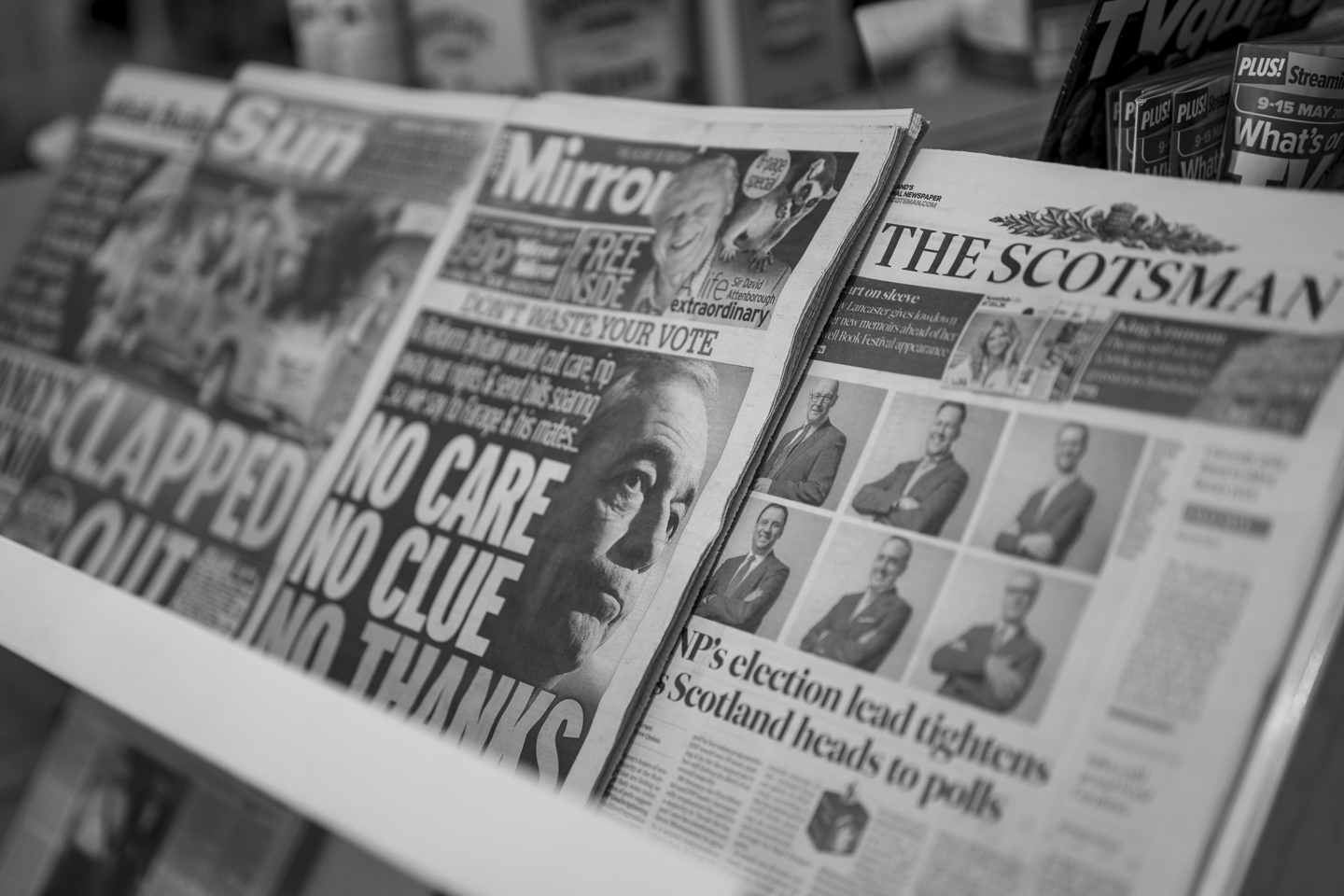
Updated findings from the UK media corpus study. The election happened. Now we can compare what the coverage suggested against what voters actually did.
On 7 May I published preliminary findings from six weeks of UK media coverage ahead of the Scottish Parliament and English local council elections. The corpus then was 53,087 headlines. It has since grown to 57,899 across the full study period.
The elections produced results. That means the pre-election coverage can now be compared against something real.
Scottish Parliament results (129 seats total): SNP 58, Labour 17, Reform UK 17, Scottish Greens 15, Conservatives 12, Liberal Democrats 10.
English local councils: Reform UK 1,454 seats (29.23% of the vote), Labour 1,068, Liberal Democrats 844, Conservatives 801, Greens 587.
Two things stand out immediately. Reform UK entered Holyrood for the first time, equal second with Labour. And the Scottish Greens, who received almost no pre-election coverage, finished third.
In the six weeks before the election, UK-wide outlets published 2.23 times more Reform-related headlines than Scottish-targeted outlets from the same ownership groups. UK-wide outlets applied fear vocabulary to those headlines at 2.48 times the Scottish rate.
Reform received 29.23% of the English vote. In Scotland, 13.2%. That is a ratio of 2.21.
I am not claiming the media caused this. There are other possible ways to explain this: Scotland has a different political landscape, a different constitutional context, different party competition. Reform's message about immigration and culture may simply have less resonance in a country with a distinct national identity and its own independence debate. UK-wide media may have been amplifying Reform because English audiences were already interested, not creating that interest from nothing.
But English and Scottish voters received measurably different information about Reform UK from the same publishers, and Reform performed measurably differently in England and Scotland on the same day. The ratios are close enough to document. What they mean is a harder question.
In the previous article I noted that the Scottish Greens co-leaders, Gillian Mackay and Ross Greer, received 40 combined mentions across the corpus versus 167 for Malcolm Offord, who was leading a party with no prior Holyrood representation.
The election result: Scottish Greens 15 seats, third largest party. Reform UK 17 seats, joint second.
Pre-election Scottish-targeted coverage: Offord 103 mentions, Mackay & Greer 29 mentions.
Scottish-targeted outlet mentions — pre-election baseline
Reform UK Scotland held no Holyrood seats before the election. Scottish Greens finished third with 15 seats.
The Greens won almost as many seats as Reform on roughly a third of the Scotland-targeted coverage. Whether that reflects editorial misjudgment, genuine Scottish audience disinterest in the Greens, or something else, the gap between coverage prominence and electoral performance is as large as any I can find in this corpus.
BBC Scotland: Ross Greer, zero mentions across the entire pre-election period, Gillian Mackay one. The party they co-lead finished third in the Scottish Parliament election.
The corpus now includes NLP structural analysis alongside the lexical device detection from the original article. This produced something I did not expect.
Scottish editions consistently use more structural contrast framing (juxtaposition, placing two things in contrast to imply a connection) than their UK-wide counterparts from the same ownership groups. Scottish Sun higher than The Sun. Scottish Daily Express higher than Daily Express.
But when UK-wide editions use structural contrast, they combine it with fear vocabulary in the same headline far more often than Scottish editions do.
| Outlet | Juxtaposition rate | Fear co-occurrence |
|---|---|---|
| The Sun | 3.16% | 7.69% of juxtaposition headlines |
| Scottish Sun | 5.65% | 1.64% of juxtaposition headlines |
| Daily Express | 2.26% | 17.24% of juxtaposition headlines |
| Scottish Daily Express | 6.88% | 3.39% of juxtaposition headlines |
Scottish editions use the structural device more. They just do not load it with fear vocabulary at the same time.
UK editions: contrast plus fear, simultaneously. Scottish editions: contrast alone.
The headline example that illustrates the difference: a UK tabloid might write "Migrants flood in while British families can't afford homes" — structural contrast, dehumanising metaphor, and fear vocabulary all in one. A Scottish edition covering similar ground is more likely to write "Scottish Government urged to address housing shortage as migration figures rise" — structural contrast, no evaluative loading.
Whether that difference reflects editorial policy, audience research, professional norms for local coverage, or something else is not something the data can tell us. What it can tell us is that the two registers are measurably distinct, and they break consistently along geographic audience lines.
One figure worth noting: 8 May 2026, the day both election results came in, produced the lowest propaganda device loading in the entire corpus.
0.196 average devices per headline. Lower than any pre-election week, lower than any post-election day.
It is the most politically significant day in the corpus, and simultaneously the most linguistically restrained. Pure results reporting displaces framing: who won, how many seats, what the share was. The positioning and urgency come back within 48 hours as commentary takes over, but for one day the coverage looked like the regulated broadcasters sound all the time.
The original article noted that BBC Scotland and STV News sit near the floor of the device loading distribution, consistent with Ofcom impartiality requirements.
After the election, both surged on constitutional coverage.
Constitutional coverage — pre vs post election
3.57x increase for BBC Scotland. 5.56x for STV News. 1.77x for BBC News and UK-wide average.
Scottish broadcasters tripled and quintupled their constitutional coverage post-election. UK-wide outlets barely moved.
The constitutional implications of Reform UK entering Holyrood, the SNP's reduced majority, and the Greens finishing third are primarily Scottish concerns. That the Scottish broadcasters covered them and the UK-wide outlets largely did not is not surprising. But the magnitude of the difference is worth noting: BBC Scotland's post-election constitutional coverage increased at twice the rate of BBC News.
The restraint during the campaign period is consistent with Ofcom requirements around impartiality in active election coverage. The surge after results came in is consistent with those requirements lifting. Whether that is what happened, or whether the election result itself simply generated more constitutional news, cannot be determined from the data alone.
The corpus and tools are available at codeberg.org/RaffKarva/uk-media-analysis under GPL-3.0. 57,899 headlines, dated and queryable. The full academic paper is in progress.
The repository contains four Python tools: an RSS harvester, a topic domain classifier, a lexical propaganda device detector, and an NLP structural analyser. All four write to a shared SQLite database and can be run independently or as a pipeline — the tools are designed as general-purpose infrastructure and are not tied to this specific research question.
The harvester is still running. Post-election coverage is accumulating. The plan is to keep this going through the next election cycle and compare.
The first article asked whether the AI bias finding from Peec AI was a model problem or a data problem.
The election gave us something to test it against. An LLM trained on this corpus, asked about the 2026 Scottish Parliament election, will tell you Reform was a major story. It will probably mention Farage. It may not mention that the Scottish Greens finished third, or that their co-leader received no BBC Scotland coverage in the six weeks before polling day.
That is not the LLM being biased. That is the model being accurate about the data it was given.
Full methodology and findings notes are available on Codeberg. The academic paper is in progress.